eforge
Agentic coding made implementation faster. eforge makes it asynchronous.
Define the change, hand it off, and come back to reviewable commits. eforge runs planning, implementation, review, and validation in the background - you return at artifact boundaries, not token boundaries.
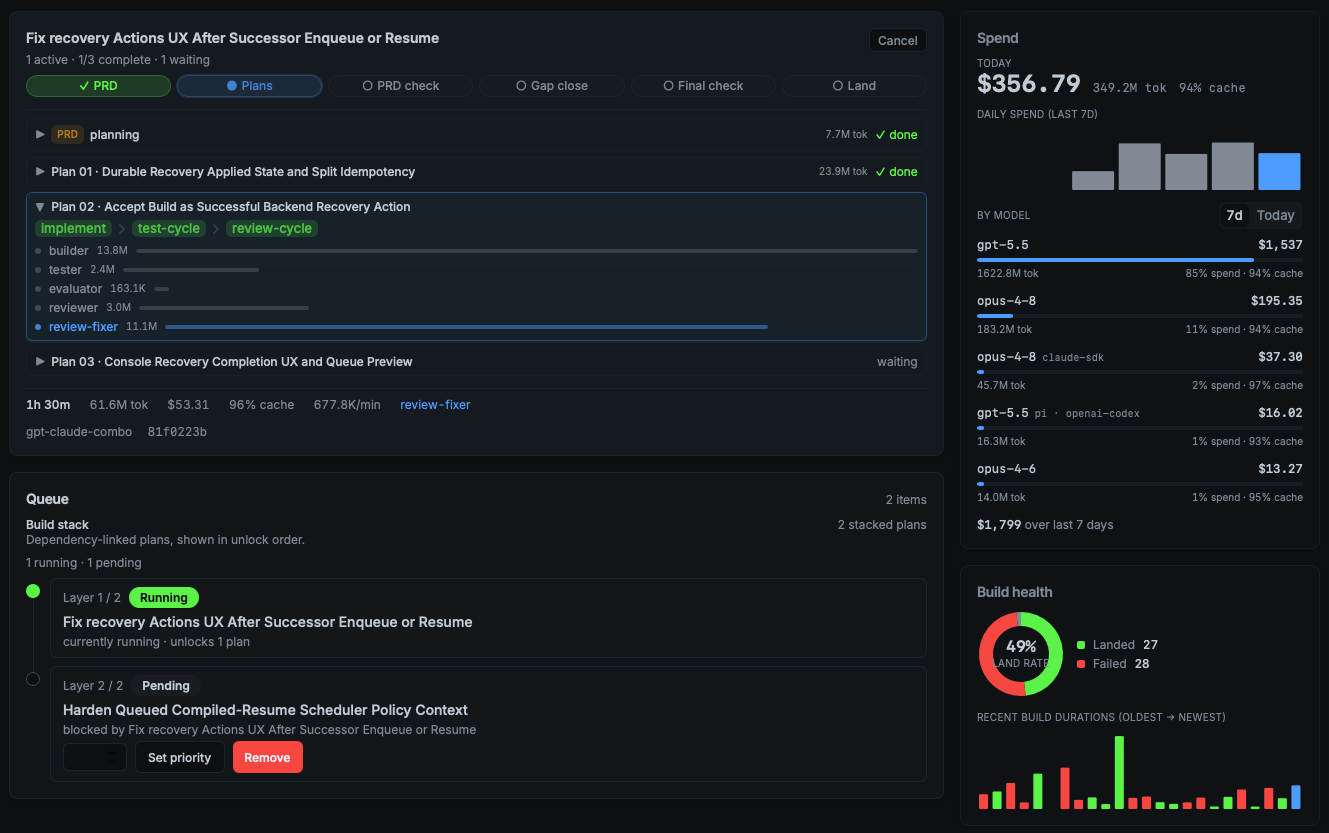
You keep the judgment. eforge runs the loop.
You plan the change: goal, context, constraints, and acceptance criteria. eforge plans and runs the build: decomposition, isolated execution, blind review, retries, merge flow, and validation. Chat transcripts are context; commits are the output.
Plan the change
Use a PRD, issue, rough prompt, playbook, wrapper app, or structured session plan to normalize intent before implementation starts.
Hand off execution
The build-engine kernel decomposes work, schedules build plans, and runs implementation in isolated git worktrees.
Automate the engineering loop
Implementation, blind review, retries, conflict handling, typed recovery, merge flow, and validation are managed without constant babysitting.
Review real outputs
You stay focused on direction and final judgment with traceable commits, logs, costs, and build decisions.
Built for repeatable, extensible handoffs
The build-engine kernel stays small - intake, worktree orchestration, conservative gates, typed recovery, evented observability. Prompts, PRDs, playbooks, session plans, profiles, wrapper apps, and extensions standardize how work is delegated, which agent runtimes run it, and what cost tradeoffs you accept.
Build profiles
Choose agent runtimes, model tiers, and execution defaults for planning, building, review, and validation.
eforge-playbooks
Install the first-party extension to capture recurring workflows as reusable input templates outside the engine kernel.
Toolbelts
Scope each agent to the MCP servers and tools it needs, while native extensions, shell hooks, and host integrations add trusted behavior around the kernel.
Bring your own credentials
Run against your chosen providers directly. No subscription wrapper, no hidden inference markup, and no single-runtime lock-in.
Choose your surface
eforge is one build engine with multiple host surfaces. Start with Pi for provider choice and direct API pricing; use Claude Code or the CLI when those fit your workflow better.
Pi extension
RecommendedRun eforge through Pi's native UX: choose your providers, pay API prices directly, and inspect every build decision locally.
pi install npm:@eforge-build/pi-eforgeClaude Code plugin
Use eforge from Claude Code when that is already your daily environment. The engine and execution profile remain separate.
/plugin marketplace add eforge-build/eforge
/plugin install eforge@eforgeCLI
Drive the engine directly for scripting and automation. After a one-time /eforge:init in Pi or Claude Code, the CLI runs builds on its own.
npm install -g @eforge-build/eforgeRead why eforge exists | Read the docs | Browse the reference | Contribute on GitHub
Built by Mark Schaake.